Homeowner guide
Flashing and chimney leaks: where most roofs actually leak
Chimneys, skylights, vents, walls and valleys. Why the metal around roof openings fails and how it's repaired the right way.
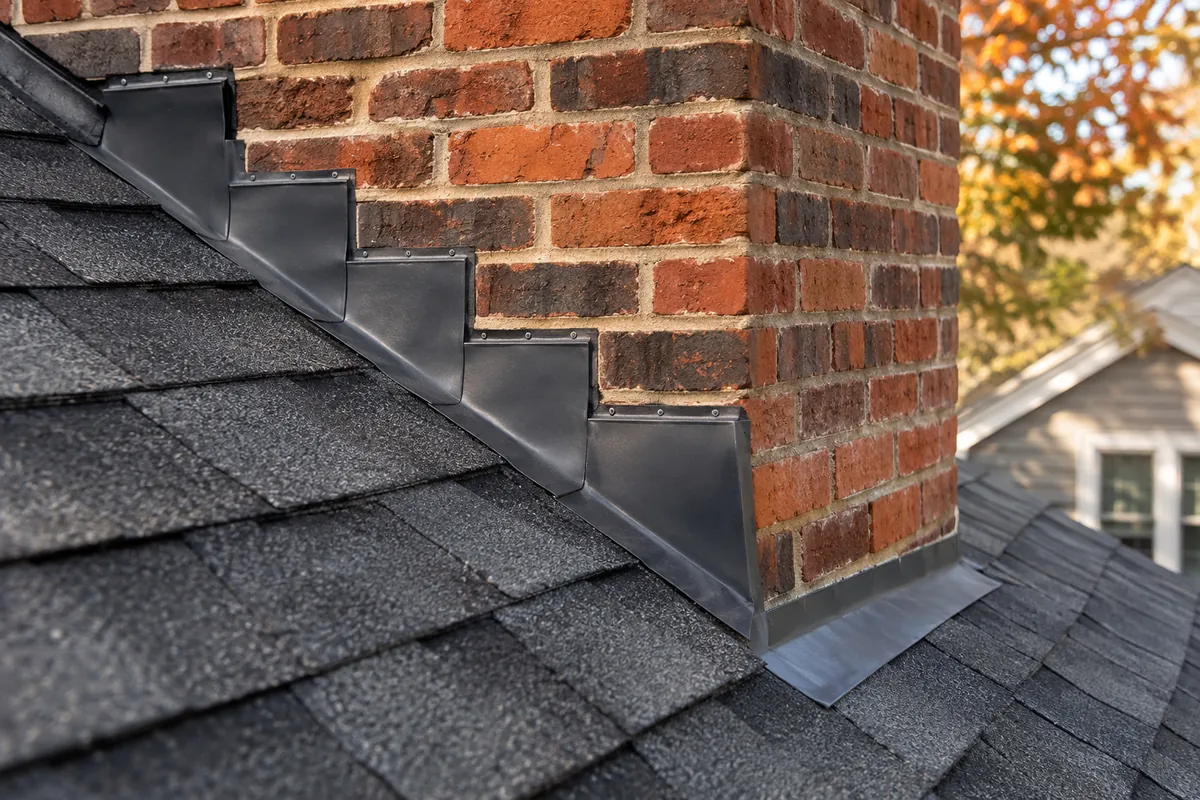
Shingles shed water well across an open slope. The trouble spots are the places where something breaks through the roof or meets it at an angle: chimneys, skylights, plumbing vents, exhaust fans, walls, dormers and valleys. At each one, metal or rubber flashing directs water back onto the shingles. When flashing is installed wrong, comes loose or wears out, water gets behind it. That's why so many leaks show up near a chimney or along an upstairs wall, even on a newer roof.
Types of flashing and how they fail
| Flashing | Where it goes | Common problems |
|---|---|---|
| Step flashing | L-shaped pieces woven in with each shingle course where the roof meets a wall or the side of a chimney | Missing pieces, one long strip used instead of individual steps, pieces nailed through the bend |
| Counter (cap) flashing | Covers the top of the step flashing on chimneys and brick walls, set into a cut mortar joint | Pulled out of the mortar, cracked sealant, set only in caulk instead of a cut joint |
| Apron & cricket | The front of a chimney, and a small peaked "saddle" behind wide chimneys that splits water around them | No cricket on a wide chimney, so water and debris pile up behind it |
| Pipe boots | Rubber or lead collars around plumbing vents | Cracked or split rubber after years of sun; missing or loose fasteners |
| Skylight flashing kits | Around skylights and roof windows | Kit not used or installed out of order; failed seals in older skylights |
| Valley flashing | Where two slopes meet | Worn or cut too short; nails too close to the center of the valley |
| Drip edge & kick-out | Roof edges, and the spot where a roof edge ends against a wall | Missing kick-out flashing, which sends water down and into the wall |
Warning signs
- Stains on the ceiling or wall next to a chimney, skylight or upstairs wall
- Water stains or wet wood on the sides of the chimney in the attic
- Flashing that's lifted, rusted, bent or held on mostly by caulk
- Cracked rubber around plumbing vents
- Dark streaks or rot on siding below where a roof meets a wall
- Crumbling mortar, missing bricks or a cracked chimney crown on top
Is it the flashing or the chimney?
Not every chimney leak is a roofing problem. Brick and mortar are porous, so water can soak through the masonry itself, or come in through a cracked crown (the concrete cap on top) or a missing chimney cap. A roofer and a chimney professional may each need to look. Clues that the masonry is the problem: wet bricks inside the attic all around the chimney, white powdery deposits (efflorescence), and leaks during long soaking rains rather than wind-driven storms.
How flashing is repaired the right way
- Replace, don't just re-caulk. Sealant has its place, but a lasting repair usually means removing the shingles beside the opening and installing new step flashing course by course.
- Counter flashing cut into the mortar. On brick, the top edge should be set into a cut joint and sealed, not just glued to the face of the brick.
- Ice and water shield underneath. A self-adhering membrane under the flashing area adds a second line of defense, especially where ice dams form.
- A cricket behind wide chimneys so water can't pond behind them.
- New pipe boots rather than patching old cracked ones. Some roofers offer longer-lasting boots or covers.
Flashing work usually needs some shingles removed and replaced. If your shingles are old or discontinued, ask how the roofer will blend the patch, and whether it makes sense to time the repair with other work. See repair or replace?
Questions to ask
- Is the water coming through the flashing, the masonry, or both?
- Will you replace the step and counter flashing, or reseal it?
- Will the counter flashing be set into the mortar joints?
- Does my chimney need a cricket or a new crown?
- Can you send photos of the problem and the finished repair?
Updated November 22, 2026. General information for homeowners, not legal or insurance advice. Your roofer, insurer or attorney can advise on your situation.